What Not To Wear When Sailing In Aruba?
The clothing, footwear and sunscreen mistakes that ruin a catamaran day in Aruba, and what to wear instead on a shared sunset sail or snorkel trip.
Sailing out of Palm Beach sounds effortless, and mostly it is. You board, someone hands you a drink, and the leeward coast of Aruba does the rest. But every crew member on this coast has watched the same small disasters repeat themselves: the person in brand-new denim on a blazing afternoon, the visitor who sprays a cloud of sunscreen across the deck at the exact moment the wind picks up, the traveler in flip-flops trying to cross a hot, wet surface with nothing between skin and nonslip grit. None of these ruin the trip entirely. All of them are avoidable with ten minutes of thought the night before.
Aruba's conditions make the stakes a little different from a sailing day in the Mediterranean or New England. The island sits outside the main hurricane belt, the sea temperature runs about 79 to 83 degrees year round, and the northeasterly trade winds blow steadily, strongest roughly February to July. That combination means you will almost never be cold, you will be in stronger sun than you expect, and the boat will be wetter underfoot than the photos suggest. The wind also means anything loose, a wide-brim hat without a strap, a paper napkin, a spray can at full pressure, becomes a problem fast.
What Not To Wear When Sailing?
The short list of what not to wear on a sailing day in Aruba: stiff new denim, all-cotton layers that stay soaked, dark heavy fabrics, hard-soled street shoes or heels, loose hats without a chin strap, jewelry that tangles, and any sunscreen containing oxybenzone, which Aruba law prohibits. Dress in quick-dry fabric, bring a strap for your hat, and check the booking page for any dress detail specific to your trip.
Denim earns its place at the top of this list by doing everything wrong at once. It holds water from spray, an accidental soak at the swim step, or plain sweat, and it dries slowly, so a two-hour sail turns into a four-hour damp chafe. Dark heavy fabrics compound the problem by absorbing the equatorial-level sun rather than reflecting any of it. The same logic applies to heavy cargo shorts with metal hardware: the hardware sits on hot surfaces and on you, and it never improves the afternoon.
Cotton deserves a specific mention because people reach for it on vacation. A cotton t-shirt is pleasant on land and miserable after one dunking. It loses its shape, clings, and stops insulating the moment it is wet, which matters on the sail home when the boat is moving and the wind feels suddenly sharp on damp skin. Quick-dry synthetics or a light rash guard do the job better, and a rash guard doubles as sun protection in the water, which matters more than most first-time visitors expect.
The Dolphin snorkel sail above is the format where clothing choices actually bite: wet gear, a swim step, and hours of open sun where the dress code drifts smart-casual. Each has free cancellation, so locking one in early costs nothing if your plans shift. If you want the full packing-side view, our what to bring guide covers towels, dry bags and the non-clothing essentials.
Why Cotton And Denim Fail On A Wet Deck
Cotton and denim fail on a catamaran because they absorb water, dry slowly, and lose both shape and comfort once wet, while the deck itself cycles between soaked, sunny and hot. On a snorkel trip with a swim stop you will get wet by design, and on a sunset sail you will get wet by spray. A quick-dry layer solves both cases for the same space in your bag.
The mechanism is simple. Cotton fibers trap water in their structure, which is why a cotton shirt feels cool on land and heavy at sea. Denim is worse because of its weight and weave: soaked denim chafes at the seams, and the seams are exactly where you sit for two hours. Meanwhile the trampoline mesh or nonslip deck of a catamaran is a surface that gets wet, heats up in the sun, and stays gritty. Sitting on it in wet denim is the classic first-timer error, and the crew will see it and quietly hand you a towel.
The failure also has a social and photographic dimension. A sunset sail along the Palm Beach coast is one of the most photographed two hours of many visitors' trips, and soaked, sagging cotton shows in every frame. Picture the scene: someone dressed for a beach bar realizes mid-sail that the outfit worked on land and collapses at sea. The fix is not dressing up, it is dressing in fabric that forgives water.
| Fabric or item | What happens on the water | Better swap |
|---|---|---|
| New denim jeans | Stays wet, chafes at seams, hot in sun | Quick-dry shorts or lightweight trousers |
| Heavy cotton t-shirt | Loses shape, cold on the sail home | Synthetic tee or light rash guard |
| Dark heavy fabrics | Absorbs sun heat all afternoon | Light colors, loose weave |
| Long flowing skirts or wide-leg pants | Tangle on ladder, railings and cleats | Fitted or knee-length quick-dry |
| Metal-studded accessories | Heat up, scratch gelcoat and skin | Leave them at the hotel safe |
Footwear Rules For A Catamaran Day
Skip hard-soled street shoes, heels, and heavy boots; bare feet, flip-flops or reef-safe water shoes are the practical picks for the deck, because dark soles mark the deck and wet fiberglass is slippery. Bring sandals you can slip off at the boarding step, and check the booking page if you are unsure whether shoes come off.
Barefoot is the default on nearly every catamaran in Noord and Oranjestad, and the reasons are practical rather than precious. Street shoes track sand and grit that then grind into the deck under bare feet, dark rubber leaves scuff marks crews scrub off later, and a wet fiberglass step is genuinely slippery in anything with a smooth sole. Heels are the extreme case: they damage decks and they are a fall risk the moment the boat heels or a wake crosses the bow.
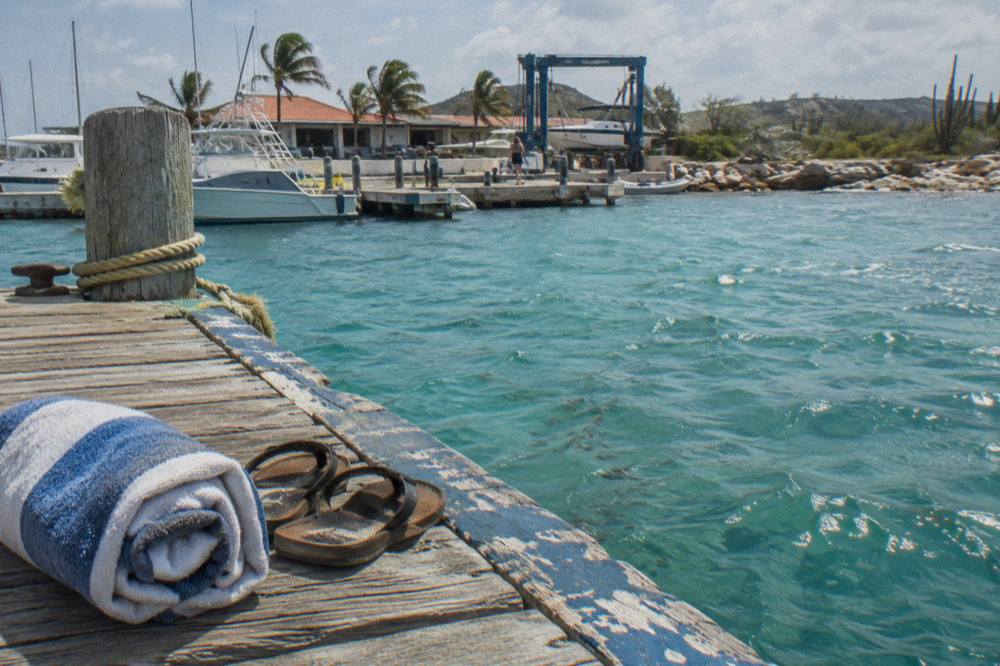
Flip-flops earn a qualified pass. They are fine for the pier and the walk from the taxi, but they are the least secure thing on a ladder at the swim stop, so most people kick them off at the rail anyway. Water shoes with a thin flexible sole are the quietly correct answer if you plan to swim at a rocky entry like Boca Catalina or stand on the shallow shelf near the Antilla, where coral rubble underfoot is real. Whatever you choose, expect to carry them aboard rather than wear them, so pick something that fits in a small bag.
One practical note for your sailing day: check-in is typically 30 minutes before departure, and towels are rarely provided on board. That means your footwear bag is also a good place for the towel nobody gave you. The same reporting flags that gratuities for the crew are customary in cash, so the pocket of whatever you wear is worth thinking about too.
Sunscreen, Spray Cans And The Reef-Safe Law
Do not bring aerosol sunscreen or any product containing oxybenzone: Aruba law has prohibited the import, manufacture, sale and free distribution of oxybenzone sunscreens since 1 July 2020, with fines reported up to Afl. 10,000. Use a mineral lotion with zinc oxide or titanium dioxide, applied before boarding, and reapply by hand during the trip.
The spray-can problem is twofold. First, a surprising share of what leaves the can never lands on you; on a moving deck with trade winds, it lands on the person next to you, the cushions, and the sea. Second, aerosols are how people unknowingly bring banned chemistry aboard, because the ingredient list on a spray can is rarely read at a beach shop. The law names oxybenzone specifically; it does not ban octinoxate, and you should not believe anyone who says otherwise. Mineral formulas with zinc oxide or titanium dioxide contain no oxybenzone, the ingredient Aruba's sunscreen law bans.
Apply the first coat on land, before check-in. It needs time to bind to skin to work, and doing it on the boat guarantees wind-drift and sunscreen on the deck. Reapply at the swim stop or mid-sail by hand, and pay real attention to the parts people miss: the tops of ears, the part line in your hair, the back of the neck, and the tops of feet, which take the full reflected glare off the water all afternoon. The reflected-light effect is why sailors burn in places the sun never directly hits.
Aruba's marine protections give this more weight than a normal beach day. Parke Marino Aruba, established by National Decree in 2018, covers four marine protected areas including Mangel Halto, and its management plan carries a no-touch policy for corals and marine life along with anchoring rules that keep boats off seagrass and coral. The official Aruba code of conduct for visitors also asks visitors not to feed marine life or pick up starfish. What you wear on your skin ends up in exactly that water, which is the whole point of the law.
What To Wear Instead: A Simple Kit
Build around three quick-dry pieces, one layer for the sail home, and a hat with a strap: a rash guard or synthetic tee, quick-dry shorts, swimwear worn under, a light windbreaker or cover-up for after sunset, polarized sunglasses with a retainer strap, and a wide-brim hat that ties on. That kit covers a morning snorkel trip and an evening sail without changing.
The rash guard is the single highest-value item on the list. It blocks sun in the water where lotion washes off, it dries in minutes, and it doubles as your shirt for the sail home. Polarized sunglasses matter almost as much: the glare off the water is constant, and polarization cuts it enough that you can actually watch for turtles and fish rather than squint. The retainer strap is not a style choice, it is arithmetic; the trade winds that make Aruba pleasant are exactly what takes an unstrapped pair off your face and into the Caribbean.
The windbreaker or cover-up answers the question people forget to ask: what happens after the sun goes down? A sunset sail departs warm and returns after dark, and the combination of motion, evening air and damp skin feels several degrees colder than the beach did. It never reaches genuinely cold on this coast, but a light layer is the difference between staying on the front net for the whole trip and retreating to the cabin at the halfway mark.
The Arusun sail is a good example of why the kit approach beats outfit thinking. The trip runs about two and a half hours, from $63 per person, rated 4.8 across 2,683 reviews, with snorkel gear and drinks included and stops at the Antilla shipwreck and Boca Catalina. That is a morning of sun, a swim, and a windy ride home in one booking, which is precisely the sequence quick-dry fabric was invented for.
Sunset Sails And Dinner Cruises: Dressing Up Without Disaster
On a sunset sail, smart-casual that survives wind and spray works: a light dress or shirt over swimwear, quick-dry for anything below the waist, and a layer for after dark; on a dinner cruise the bar rises slightly but the deck is still wet, so skip long trailing hems, delicate fabrics and heels entirely. Dress for the sea without worry, as catamaran cruises stay casual.
The sunset format is where clothing regrets concentrate, because it is the trip people dress up for. The instinct is reasonable, the light at that hour is spectacular and everyone wants the photo. The execution is where it fails: a long flowing dress on a boat with railings, cleats and a boarding ladder is a tripping hazard with good posture, and delicate fabrics that spot with salt water do not recover before dinner. The compromise is simple, dress the top half up and the bottom half for a boat.
The dinner cruise raises the stakes only slightly. A trip like the Aruba Sunset Sail Dinner Cruise with Open Bar, from $137 per person, rated 4.8 across 456 reviews, with a meal and drinks included, sits at the smart-casual end of the Aruba sailing spectrum. It boards at Piet's Pier Bar and sails the Palm Beach coast, and the same physics apply as on every other catamaran here: the step is wet, the wind is real, and the sail home is after dark. Flat shoes or good sandals, a layer, and nothing that cannot take a drop of sea spray.
Our related featured pick, the Aruba Sunset Catamaran Sail with Appetizers and Open Bar, from $92 per person and rated 4.5 across 2,407 reviews, is exactly the two-hour format this section's advice is built for: appetizers, an open bar, the Palm Beach coast at golden hour, and a deck that will be damp somewhere. For a broader look at the format itself, the sunset cruise guide compares the options across price and pier.
Timing, Seasons And Why It All Matters More Here
Aruba's trade winds run strongest roughly February to July, mornings bring the flattest, clearest water, and September to November is among the calmest stretches of the year for sea conditions, so what you wear should match your slot: wind-proof layers for afternoon sails, full sun kit for morning snorkel trips, and reef-safe sunscreen on every single one of them.
The seasonal pattern drives the clothing logic more than visitors expect. The island lies south of the main hurricane belt, whose season runs 1 June to 30 November, and direct impacts are rare, but the wind is a constant companion, strongest in the first half of the year. An afternoon sailing slot means building chop and building breeze by the hour, which is why loose hats, paper-light scarves and anything not attached to you should stay ashore. A morning slot means calmer water for the swim stop but a lower sun that climbs fast, so the rash guard and the pre-boarding sunscreen coat earn their keep.
The reflected-light and wind-chill effects are the two things people consistently under-prepare for, and they point in opposite directions. Before sunset you will be hotter than the thermometer suggests, because the water bounces UV back at you from below. After sunset you will be cooler than the thermometer suggests, because you are probably damp and the boat is moving through its own breeze. A kit with one warm-weather setup and one light layer handles both ends without any thought.
The Short Version To Remember
Wear quick-dry, light-colored layers over swimwear, sandals that slip off, a strapped hat and polarized sunglasses; skip denim, cotton, heels, loose hats, trailing hems and aerosol or oxybenzone sunscreen; and bring one light layer for after dark plus your own towel. That single kit works for every catamaran trip on this coast, from a $63 snorkel sail to a $172 four-course dinner cruise.
The through-line of this whole article is that a catamaran is a wet, sunny, windy machine, and clothing that fights any of those three facts loses. Visitors who dress for the sea look more relaxed in the photos because they are more relaxed, they swim when the boat stops, they stay on the front net after sunset, and they are not negotiating with a pair of soaked jeans at the rail. The mistakes are all cheap to avoid and expensive to make, in comfort terms, on a two-hour window you planned for months.
One last framing helps: pack for the swim, then dress for the drink. Everything below the waist should survive total immersion gracefully, everything above it should survive wind and sun, and the space between those two rules is where nearly every sailing wardrobe mistake on this island lives. Check the booking page for anything specific to your trip, such as an adults-only age limit or a hotel pickup detail, and the rest of the decisions are yours.
Whether you land on the appetizer sunset sail, the Dolphin Catamaran snorkel trip from $69 per person, rated 4.8 across 2,894 reviews, or the dinner cruise, all three carry free cancellation and drinks included, so the outfit is the only variable left to get right. Aruba Catamaran Tours keeps the full set of options, piers and price ranges in one place if you are still comparing.
Common Questions About What Not To Wear When Sailing
What Not To Wear When Sailing?
Do not wear new denim, all-cotton layers, dark heavy fabrics, hard-soled street shoes, heels, loose hats without a strap, or any sunscreen containing oxybenzone, which Aruba law prohibits. Wear quick-dry layers over swimwear, sandals that slip off, a strapped hat, polarized sunglasses and one light layer for the sail home after dark.
Do You Wear Shoes On A Catamaran In Aruba?
Usually not on deck. Most crews ask for bare feet aboard because street shoes mark the deck and track grit, so bring flip-flops or sandals for the pier and a bag to carry them in. Thin-soled water shoes are a good choice if your trip has a swim stop at a rocky or coral-rubble entry. Check the booking page if you are unsure for your specific trip.
What Kind Of Sunscreen Is Allowed In Aruba?
Mineral-based sunscreen with zinc oxide or titanium dioxide. Aruba has prohibited the import, manufacture, sale and free distribution of sunscreens containing oxybenzone since 1 July 2020, with fines reported up to Afl. 10,000. Avoid aerosol sprays entirely, apply your first coat on land before check-in, and reapply by hand during the trip.
Should I Dress Up For A Sunset Sail Or Dinner Cruise?
Dress the top half up and the bottom half for a boat. A light dress or shirt over swimwear works for a sunset sail; on a dinner cruise, smart-casual quick-dry pieces are the safe call. Skip long trailing hems, delicate fabrics and heels, because the boarding step is wet and the deck moves. Bring a layer for after dark.
Will I Get Wet On A Catamaran Tour Even If I Do Not Swim?
Probably. Spray, wet seats after the swim stop, and the walk to the rail are all normal parts of the trip, which is exactly why denim and cotton fail. Quick-dry fabric forgives all of it. If your trip includes snorkeling, gear is included on the tours that list it, but a towel usually is not, so bring your own.
Is A Hat Worth Bringing On A Windy Day?
Yes, but only one with a chin strap or tie. The same trade winds that keep the boat comfortable take unstrapped hats overboard regularly, and the island's shops sell strapped versions for exactly this reason. A wide brim with a strap beats a cap for sun coverage, and a retainer strap for sunglasses is the companion piece.